-
- All Centrifuges
- Benchtop Centrifuges
- Floor-Standing Centrifuges
- Refrigerated Centrifuges
- Microcentrifuges
- Multipurpose Centrifuges
- High-Speed Centrifuges
- Ultracentrifuges
- Concentrator
- IVD Products
- High-Speed and Ultracentrifuge Consumables
- Centrifuge Tubes
- Centrifuge Plates
- Device Management Software
- Sample and Information Management
-
- All Pipettes, Dispensers & Automated Liquid Handlers
- Mechanical Pipettes
- Electronic Pipettes
- Multi-Channel Pipettes
- Positive Displacement Pipettes & Dispensers
- Pipette Tips
- Bottle-Top Dispensers
- Pipette Controllers
- Dispenser & Pipette Accessories
- Automated Pipetting
- Automation Consumables
- Automation Accessories
- Liquid Handler & Pipette Services
You are about to leave this site.
Please be aware that your current cart is not saved yet and cannot be restored on the new site nor when you come back. If you want to save your cart please login in into your account.
384-well plates vs 96-well plates - Which is best?
Lab Academy
- Cell Biology
- Pipetting & Dispensing
- Efficiency
- Pipettes
- Pipette Tips
- Essay
It cannot be ignored: The workload in labs is constantly growing. 25 years ago, working with 96-well microplates may have been progressive but nowadays an increasing number of labs are changing to 384-well plate format. Super, now you have four 96-well plates on a single plate – just with wells in miniature format. But what is the advantage? When comparing 384-well plate vs 96-well plate formats, the differences in efficiency and costs become clear. Let´s take a closer look at the advantages of 384-well plates.
When debating the benefits of 384-well plate vs 96-well plate formats, storage space is a major advantage. Instead of storing four 96-well plates, you only need room for one plate. That looks especially good in the fridge, the freezer or the store cupboard. But it gets even better: One tip box or rack contains 4 times more tips than the standard (96) format - saving you a lot of space on the bench. This makes two real plus points! Less material also means that you can organize your workspace more efficiently and therefore save time.Another key factor when comparing 384-well plates vs 96-well plates is reagent volume.
In cases where it is possible to run an analysis using lower volumes, e.g. 40 µL instead of 150 µL, the 384-well plates provide many advantages. First and foremost, you save reagent. For example: Four 96-well plates filled with 120 µL per well need a total volume of approximately 46 mL. If the same analysis is miniaturized to a reaction volume of 40 µL per well, the total volume is decreased to 15 mL.
Expensive reagents such as those used in molecular biology can be saved and the cost per analysis reduced. Of course, this is only feasible if the reaction or analysis can be miniaturized.
Are you able to fill a 384-well plate manually within a minute?
Another advantage is you save time. Are you able to fill a 384-well plate manually within a minute? The answer to this question is that it highly depends on the type of pipette you use.
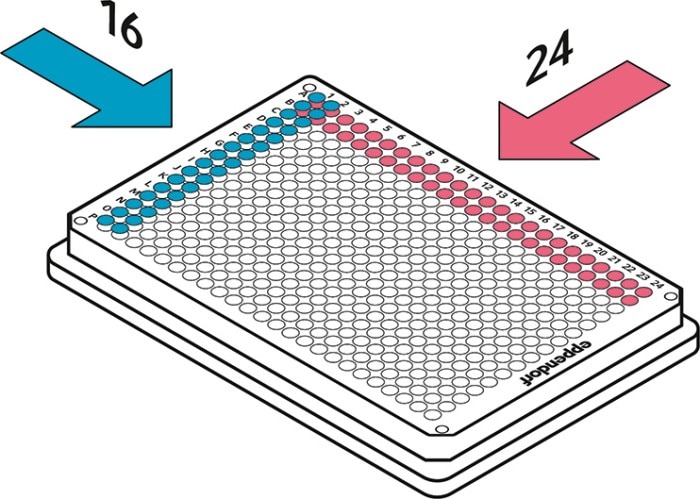
It is possible to fill 384-well plates with 8 or 12-channel pipettes. But then only every second well can be filled at one time.
On the one hand, this is highly error-prone ("oh, my centrifuge is ready… which was the next well to be filled?"). On the other hand, it is tiring and time-consuming. Just switching the plates to 384-well format and filling them with 8/12-channel pipettes is false economy.
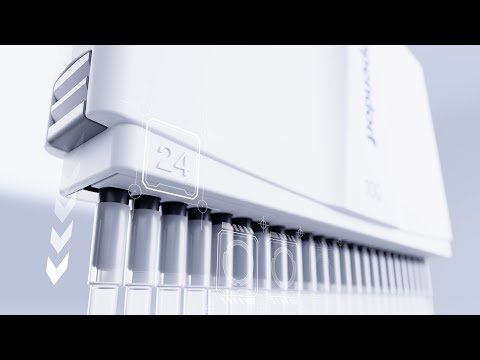
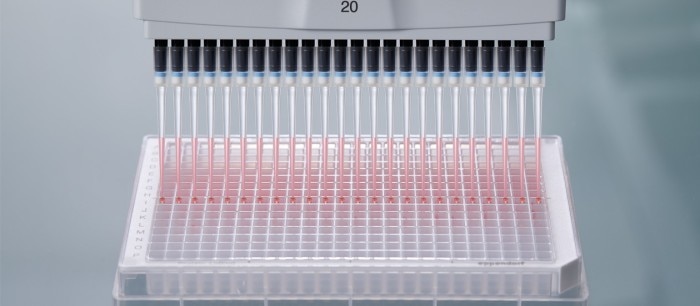
What you need is a reliable 16 or 24-channel pipette whose cone distances are harmonized to the distance between wells of a 384-well plate. And suddenly the work becomes more efficient.
Read more
Once you are holding the optimal tool, you can get started. How much time do you think can be saved with a 24-channel pipette compared to a 12-channel? Lab personnel that had the chance to apply such an innovative pipette/pipette tip system reported: "3 times as fast as with 12-channel" and "50 % time saving" as well as "we have saved a complete working day". As an additional side-effect, incubations on a plate do not need to be started staggered or row-wise. You can now fill a plate in less than a minute.
384-well plate vs 96-well plate formats: which wins the battle?
Ultimately, the choice between 384-well plate vs 96-well plate formats depends on your lab’s throughput and resource priorities. If you can miniaturize your assays and you have 16/24-channel pipettes at hand, then 384-well plates are the winner in terms of efficiency, space, and costs.
But using the right tools is essential! Recognising this, the new Eppendorf Research plus and Xplorer plus 16/24-channel pipettes and pipette tips epT.I.P.S.® 384 are optimized for our 384-well plates, letting you work with speed and accuracy.
Read more
Related documents

Eppendorf solutions
Read more
Upcoming Webinars
Read more
Videos not loading, because cookies have been rejected. Change your